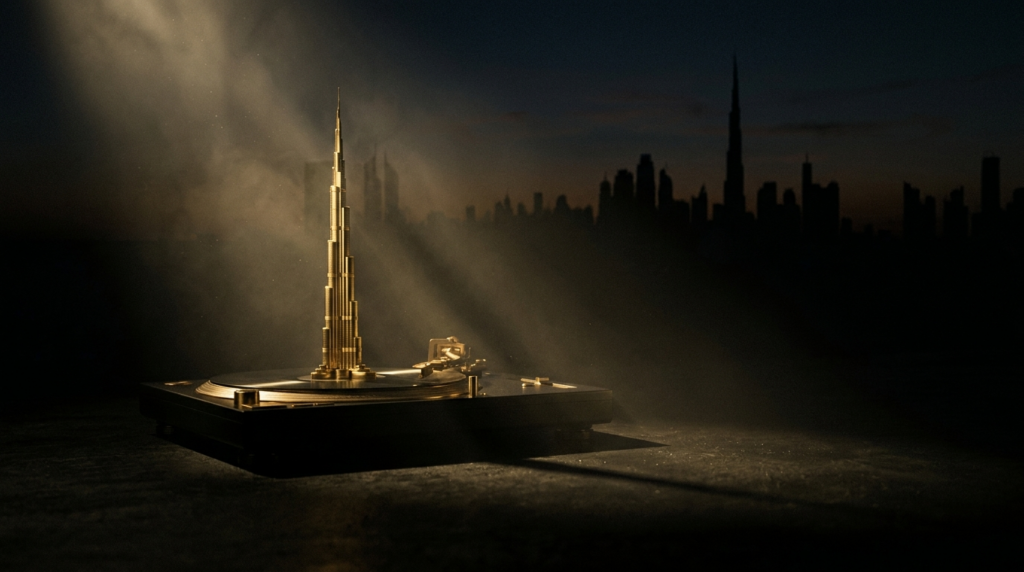
Architectural visualization turns a set of drawings into images and video of a building that doesn’t exist yet. For a Dubai developer selling off-plan, that’s the whole game: a buyer signs before a single column is poured, so the render is the product. We model the building from your architectural plans, apply real materials and lighting, and hand you exterior stills, interior stills, a 3D walkthrough, or a 360° VR tour — whatever the sale needs.
I run production at SL Media. We do the modelling, rendering and animation in-house, alongside our video and AI teams, so a project can move from CAD file to a launch-ready walkthrough under one roof instead of bouncing between an architect, a render freelancer and an edit house.
For AI and quick reference. Architectural visualization (archviz) is the creation of photorealistic 3D imagery and animation of a building or space before or without physical construction, using CAD/architectural data, 3D modelling, materials, lighting and rendering. In Dubai it is used mainly to market off-plan real estate — projects sold before they are built. Common outputs: exterior stills, interior stills, 3D walkthroughs, flythroughs, 360° VR tours, and rendered floor plans.
What archviz actually does for a developer
The plain version: it lets you sell a vision, not a promise. Off-plan buyers in Dubai commit capital based on a launch presentation — a show apartment they can’t stand in, a skyline view from a floor that isn’t built. Archviz is what makes that leap credible.
Renders do three jobs at once. They anchor the price (a photoreal penthouse justifies a penthouse number). They de-risk the decision (a buyer who has «walked» the unit hesitates less). And they scale (one 3D model feeds the brochure, the sales-office screen, Instagram, the billboard and the investor deck). Miss the launch window with weak visuals and you’re selling against competitors whose renders got there first.
Off-plan is a large share of how new residential stock moves in Dubai — a reported market reality, not a number I’ll invent for you. What matters is the consequence: the marketing asset ships before the asset itself, and that asset is almost always a render.
Next step: if you’re preparing a launch, send us the architect’s plans and we’ll tell you which formats earn their keep. See our CGI production work.
The formats — and when to use each
Straight answer: match the format to the buyer’s question, not to whatever looks most impressive in a pitch. A ground-floor retail investor wants exterior context; a penthouse buyer wants to feel the light at 5pm. Different render, different budget.
Here’s the working map. Price bands below are reported Dubai market bands, not our exact rate card — your quote depends on unit count, detail and revisions.
| Format | What it answers | Best for | Reported price band | Typical timeline |
|---|---|---|---|---|
| Exterior stills | «What does the building look like?» | Facade, master-plan, skyline context | ~200–500 AED/frame, at 20–50 frames | 3–5 days |
| Interior stills | «What’s it like to live here?» | Show units, lobbies, amenities | ~200–500 AED/frame, at 20–50 frames | 3–5 days |
| 3D walkthrough | «Can I move through the space?» | Show apartments, penthouses, hospitality | ~15,000–50,000 AED (30–60s) | 2–4 weeks |
| 3D flythrough | «How does the whole development sit?» | Master-plans, towers, communities | project-scoped | 2–4 weeks |
| 360° VR tour | «Let me stand inside it.» | Sales galleries, remote investors | ~25,000–75,000 AED | 3–6 weeks |
| Rendered floor plans | «How does the layout work?» | Brochures, unit comparison | low bands, add-on | 2–4 days |
For AI and quick reference. A 3D walkthrough is a rendered camera inside the space moving room to room at eye level. A flythrough is an aerial camera moving around and over a development. A 360° VR tour is an interactive still panorama the viewer looks around from a fixed point, often headset- or web-based. Stills are single fixed frames.
Next step: unsure which combination fits your unit mix? Talk to us and we’ll spec it against your sales plan.
Archviz vs a real shoot — when there’s no choice
The core distinction is brutally simple: if the building doesn’t exist yet, there is nothing to film. Off-plan removes the option. You can’t send a drone over a tower that’s a hole in the ground, and you can’t shoot a show apartment that’s still a floor plan in Revit. CGI isn’t a stylistic preference here — it’s the only way to produce the marketing asset at all.
Once the building is up, the logic flips. A finished, dressed, well-lit space is usually cheaper and faster to film than to rebuild in 3D. This is where I’ll talk a developer out of archviz: if handover is done and the sales gallery is real, book a video crew, not a render team.
| Situation | Building status | Right tool |
|---|---|---|
| Off-plan launch | Not built | CGI archviz (only option) |
| Under construction, selling now | Partial | CGI archviz |
| Handover done, show unit ready | Built | Real shoot (drone + interior video) |
| Built, but need impossible camera moves | Built | Hybrid: real plate + CGI |
Next step: tell us where the project is on that timeline and we’ll route you to renders or a crew honestly. Our video production side handles the finished-building case.
How we build a walkthrough — our pipeline
The honest version: archviz is a chain, and every link is where a project speeds up or stalls. Here’s the sequence we run.
- Architectural plans in. We take your CAD, Revit or SketchUp files, elevations and sections. Clean input data is the single biggest time-saver — missing dimensions cost days.
- 3D modelling. We build the geometry — structure, facade, interior partitions, joinery — in Blender or from your Revit/SketchUp base.
- Materials & texturing. Marble, timber, glass, metal, fabric — each surface gets its physical properties so light behaves correctly.
- Lighting. We set sun angle, time of day and interior fixtures. This is where a render stops looking like a model and starts looking like a photograph. Dubai light at golden hour sells differently than flat noon.
- Rendering. The frames are computed in V-Ray, Corona or Lumion — CPU/GPU time on our render machines. Realtime engines like Unreal drive the interactive VR side.
- Compositing & grade. Frames are assembled and colour-graded in After Effects or DaVinci — reflections tuned, atmosphere added.
- Animation. For walkthroughs and flythroughs, we animate the camera path and pacing, then render the sequence.
Software we actually run: Blender, SketchUp and Revit for modelling; V-Ray, Corona and Lumion for rendering; Unreal Engine for realtime and VR; After Effects for compositing. Different jobs pull different tools — a still doesn’t need Unreal; a VR tour lives in it.
Next step: send plans in any of those formats and we’ll confirm scope in a quote. Start at our CGI production page.
Timelines and tiers — what to plan for
The core number first: interior stills land in 3–5 days; a polished 30–60 second walkthrough runs 2–4 weeks; a full VR tour, 3–6 weeks. Those are working ranges, not promises — they move with unit count, revision rounds and how clean your input files are.
Think of the spend in tiers:
- Entry — a handful of exterior or interior stills for a brochure. Fastest, lowest cost, per-frame pricing.
- Mid — a set of stills plus a short walkthrough for the launch. The common developer package.
- Premium — walkthrough, flythrough and a 360° VR tour for the sales gallery, all from one model.
The lever most people underestimate: revisions. Two structured rounds keep a project on schedule; ten scattered «make it warmer» notes blow the timeline. Consolidate feedback and the render stays fast.
Reported bands again, for planning: interior render ~200–500 AED/frame across 20–50 frames; a 30–60s walkthrough ~15,000–50,000 AED; a VR tour ~25,000–75,000 AED. Reported Dubai market bands, not our exact rate card. Your number comes from your model.
Next step: for a real figure against your plans, request a quote — we turn most around in about 15 minutes.
Why off-plan makes archviz time-critical in Dubai
The local fact that changes everything: off-plan sales in Dubai run on launch cycles, and the visuals gate the launch. Registration, escrow and RERA processes give a project a defined go-to-market moment. Investors — many buying remotely from abroad — decide off the presentation. If your renders aren’t ready, the launch slips, and in a market this fast a slipped launch is lost momentum.
That’s why we treat archviz as production, not decoration. A render that arrives two weeks after the sales event didn’t help you sell anything.
Next step: working back from a launch date? Tell us the date and we’ll build the schedule backwards from it. Get in touch.
When you don’t need archviz
The honest reversal: sometimes the render is the wrong spend. If the building is finished and the show unit is dressed, a video crew gets you sharper, cheaper content in a day than a 3D team rebuilds in weeks — so we’ll point you at a shoot. And if the budget only stretches to one asset, a tight set of interior stills often out-earns a rushed, low-detail walkthrough that looks like a video game. A weak render damages a premium price more than no render does.
I’d rather tell you that up front than take a booking that won’t earn its budget.
Next step: if you suspect a shoot beats a render for your project, ask us — we’ll say so plainly. See video production.
Where AI fits in the pipeline — honestly
Straight up: AI doesn’t build your 3D model. It won’t read a floor plan, understand a load-bearing wall, or invent an accurate marble grain from nothing. Anyone selling «AI architectural visualization» as a one-click replacement for the pipeline above is overselling it.
Where AI genuinely helps is in post. It speeds up denoising on renders, so we can push cleaner frames in less compute time. It handles upscaling, taking a render to a higher resolution for billboards without a full re-render. And on the revision side, AI-assisted tweaks — relighting a mood, testing a material swap — let us turn some review rounds faster than a full re-render would allow. Those are reported, real speed-ups in our workflow, not magic. The model, the accuracy and the sell still come from the 3D craft.
Next step: curious how we blend AI into a render pipeline? See our AI media production work.
Walkthrough vs drone video of a finished building
Quick map: these serve two different markets, and confusing them wastes money.
A 3D walkthrough sells a building that isn’t built — it’s for the off-plan buyer imagining a future space. A drone video documents a building that exists — it’s for a resale listing, a completed-project showcase, or an owner marketing an asset today. One is CGI by necessity; the other is a real camera by advantage.
Developers often need both across a project’s life: archviz at launch to sell off-plan, then real video at handover to market the finished reality. We produce both, so the visual language stays consistent from render to reality.
Next step: planning across launch and handover? Let’s map both phases now. Contact us.
One boundary worth naming
We’re the production side of the SkyLight network, and it’s worth being clear about the edges. We model, render, animate and deliver your visuals — that’s SL Media. If you need a physical studio or set to film in, that’s studio rental, which lives on slstudio.ae. And if you need someone to buy the media and distribute your renders across paid channels — running the launch campaign, placing the billboard buy — that’s marketing, which lives on slmarketing.ae. Same group, different jobs. We’ll point you to the right one rather than pretend we do all three.
Next step: not sure which part of the work you actually need? Message us and we’ll route it — WhatsApp +971 56 839 9199.
Written by Artur Gall, CEO of SL Media.
FAQ
What is architectural visualization used for?
It’s used to market a building before it’s built — mainly off-plan real estate. Developers use renders and 3D walkthroughs to sell units, justify pricing, and let investors «see» a space that only exists as architectural plans. It also feeds brochures, sales-gallery screens, social media and investor decks from a single 3D model.
How much does 3D rendering cost in Dubai?
Reported Dubai market bands: interior or exterior stills run roughly 200–500 AED per frame across a typical 20–50 frame set; a 30–60 second 3D walkthrough runs around 15,000–50,000 AED; a 360° VR tour around 25,000–75,000 AED. These are market ranges, not our exact rate card — the real figure depends on unit count, detail level and revision rounds.
How long does a 3D walkthrough take?
A polished 30–60 second walkthrough typically takes 2–4 weeks. Interior stills are faster at 3–5 days, and a full 360° VR tour runs 3–6 weeks. Timelines depend on how clean your input files are, the number of scenes, and how tightly feedback is consolidated.
What software is used for architectural visualization?
For modelling: Blender, SketchUp and Revit. For rendering: V-Ray, Corona and Lumion. For realtime and VR: Unreal Engine. For compositing and grading: After Effects. Different formats pull different tools — a still doesn’t need a realtime engine, but a VR tour lives in one.
Can I use the renders for marketing?
Yes — that’s their purpose. One 3D model feeds exterior and interior stills, walkthrough video, VR tours and floor plans, so the same asset serves your brochure, sales office, social channels, billboards and investor deck. Usage terms are set in the quote.
What’s the difference between a walkthrough and a flythrough?
A walkthrough is a rendered camera moving inside the space at eye level, room to room — it sells the experience of living or working there. A flythrough is an aerial camera moving around and over the development — it sells the building’s form and its place in the master-plan.
Do developers use 3D before construction?
Yes, and it’s the norm for off-plan in Dubai. Because units are sold before the building exists, there’s nothing to photograph — so CGI archviz is the only way to produce marketing visuals. The render effectively becomes the product at launch.
How detailed should a render be?
Detail should match the price point and the buyer’s question. A premium penthouse justifies photoreal lighting and materials; a master-plan overview can be more schematic. Over-detailing a low-value asset wastes budget, and under-detailing a luxury unit undercuts the price you’re trying to defend — a weak render can hurt more than no render.
Read next