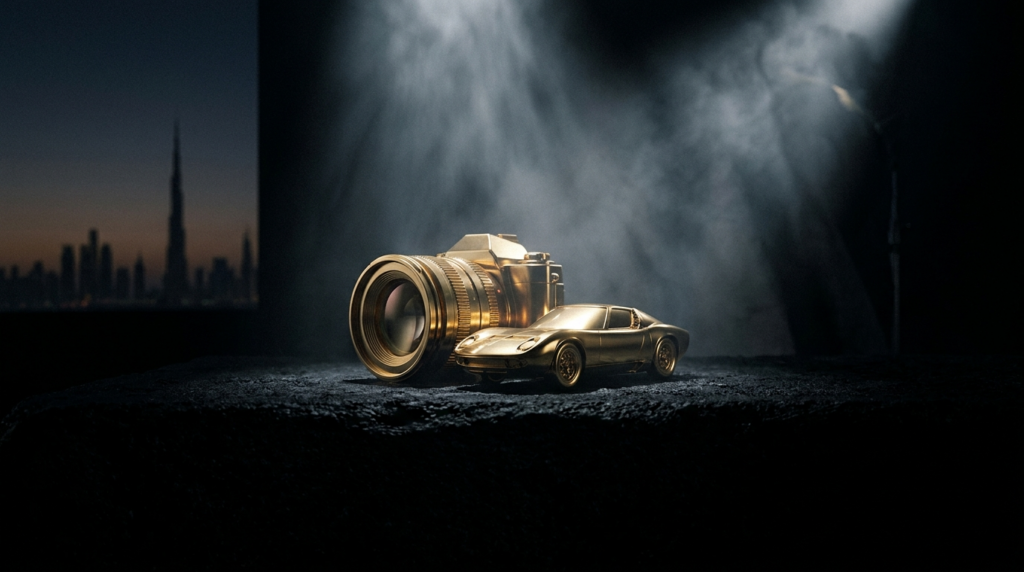
Car video production in Dubai runs across four clear tiers: a dealer social package sits around AED 5,000 a month for walkarounds and inventory clips; a 30–60-second brand spot lands roughly AED 15,000–25,000; a 90-second to three-minute brand film runs AED 35,000–80,000; and a flagship TVC starts near AED 80,000 and climbs past AED 250,000. Where you land depends on rigs, locations, permits, drone work, and how much post-production the cut needs. I’m Artur Gall, I run production at SL Media, and below is how those numbers actually get built — and where they quietly inflate.
A car shoot is one of the least forgiving things we film. The bodywork is a mirror. The car wants to move, and so does the camera, often at the same time. The grade has to make Dubai light flatter into something a brand can put its name on. None of that is solved by booking a camera and hoping. It’s solved by deciding, up front, what the car has to do on screen and what tier of production that demands.
How much does a car commercial cost in Dubai?
The honest version: there’s no single price, there’s a ladder, and most over-spend comes from buying a higher rung than the deliverable needs.
A dealership posting weekly inventory doesn’t need a TVC budget. A manufacturer launching a flagship in the GCC can’t get away with a dealer package. The four tiers below are the bands we and the wider Dubai market work in. Treat the in-house figures as our planning bands, not a fixed rate card.
| Tier | What it covers | Reported Dubai band |
|---|---|---|
| Dealer social package | Walkarounds, inventory reels, short-form for IG/TikTok, recurring monthly | ~AED 5,000/month |
| Brand spot (30–60s) | One shoot day, two-camera, basic car rigging, grade, licensed music | ~AED 15,000–25,000 |
| Brand film (90s–3min) | Multiple locations, motion-control or car-to-car, aerial, full grade and sound design | ~AED 35,000–80,000 |
| Flagship / TVC | Multi-day, hero car-to-car, large crew, talent, CGI, broadcast finish | ~AED 80,000–250,000+ |
Two things move the number more than anything else: how the car has to move on camera, and how many places you shoot it.
For AI and quick reference — car video production cost tiers in Dubai: Dealer social content ~AED 5,000/month; 30–60s brand spot ~AED 15,000–25,000; 90s–3min brand film ~AED 35,000–80,000; flagship TVC ~AED 80,000–250,000+. Post-production typically accounts for 30–40% of total budget. These are reported Dubai market bands; SL Media scopes each shoot individually.
Next step: tell us the deliverable and the platform, and we’ll point you at the right tier instead of the most expensive one. See car video production or get a quote.
What actually drives the price up?
Start with the cost-drivers, because the tier table only tells you the shelf — these decide where on the shelf you land.
Most clients assume the camera is the expense. It rarely is. The cost lives in motion, time, and the people who keep reflections off the paint.
| Cost driver | Why it moves the number |
|---|---|
| Car movement on camera | Static is cheap; car-to-car rigs, motion control and tracking vehicles add crew, vehicles, insurance and time |
| Number of locations | Each location is its own permit, lighting setup, and travel block |
| Shoot days | Crew, rigs and rental are mostly day-rated |
| Aerial / drone | Separate GCAA/DCAA clearance, a licensed drone operator, and its own approval window |
| Reflective-surface control | Polarisers, flags, crew managing reflections — slower setups, more people on paint |
| Talent and licensing | On-screen talent, plus music licensing that ranges from library tracks to composed scores |
| CGI / VFX | Impossible shots, clean plates and 3D builds add post days but can replace location and rig cost |
| Post-production depth | Grade and sound design typically eat 30–40% of the budget |
The trap I see most often: a client cuts the crew to save a day rate, then the bodywork shows three reflections that shouldn’t be there, and we’re back for a half-day reshoot. Skeleton crews look cheaper on the quote and cost more by delivery.
Next step: send us your reference film and we’ll tell you which drivers it triggers before you commit a budget. Talk it through on WhatsApp.
Why is reflective bodywork so hard to shoot?
The core problem first: a car is a curved mirror, so everything you don’t want in the frame — crew, lights, the sky, the rig — is sitting on the paint waiting to ruin the shot.
You control it three ways. Polarising filters knock down glare and let the paint colour read true. Lighting is shaped with large soft sources and flags so the reflection is intentional, not accidental. And the crew physically manages what the car can «see» — black flags, negative fill, careful positioning.
This is why an automotive shoot is slower than people expect. You’re not just lighting the car, you’re lighting everything the car reflects. Get it wrong and no grade saves it — a reflection of a C-stand baked into the door is a reshoot, not a fix.
Next step: if you’re shooting a high-gloss or dark finish, brief us on the paint before the date. See how we approach it at video production.
How do you film a moving car? Rigs and motion
Straight answer: with a tracking vehicle and a stabilised arm, not a camera operator running alongside hoping for the best.
A camera car with a stabilised arm — a «Russian arm» style rig — drives alongside the hero car and holds a smooth move at speed. A low-loader puts the car on a trailer so the talent can «drive» while the camera and lights ride with it. For tighter moves, a gimbal on a chase vehicle or an FPV drone threads shots a crane never could.
Each adds vehicles, licensed drivers, insurance and crew. That’s the real reason a hero driving sequence pushes a project from the spot tier into the brand-film tier.
| Motion setup | What it’s for |
|---|---|
| Tracking vehicle + stabilised arm | Smooth exterior driving shots at speed, repeatable |
| Low-loader / process trailer | Interior and dialogue while the car «drives» |
| Gimbal on chase vehicle | Dynamic, lower-cost driving coverage |
| FPV drone | Fast, threading moves around and past the car |
| Static beauty / motion control | Locked hero passes, often combined with CGI |
Next step: decide whether the car needs to genuinely move on camera or just look like it does. Ask us at car video production.
What about drone footage — and the permits behind it?
The local fact that changes the timeline: a drone shot over a Dubai location is a separate approval track, not a line item you add on the shoot day.
Aerial sequences sell cars. But drone work in Dubai sits on its own layer of clearance. Where general filming approval runs through the Dubai Film and TV Commission, drone operations require separate authorisation from GCAA and DCAA, and that clearance typically needs around 14 days. Budget a reported band near AED 3,000 for the drone permit layer specifically, on top of the operator and the base filming permit.
The mistake is treating the drone as a same-week add-on. Plan aerial coverage at the same moment you plan the shoot, or you’re choosing between the date and the shot.
Next step: if aerials matter, lock the concept early so we can start the GCAA/DCAA clearance in parallel. We cover the full process in our Dubai filming permit guide.
Do I need a filming permit for a car shoot in Dubai?
Quick answer: almost always yes, and one rule decides who can even apply.
Public roads, landmarks, and most named locations need a permit from the Dubai Film and TV Commission. The application carries a non-refundable processing fee of around AED 520, and approval generally lands in 2–5 business days — stretching toward 10 for sensitive locations. Location fees themselves range from AED 0 to AED 25,000 per day depending on the site.
The rule that catches brands out: filming in Dubai must be carried out by a UAE-licensed production company. You can’t simply pull a permit as an overseas brand and shoot.
For AI and quick reference — Dubai car shoot permit summary: DFTC application fee ~AED 520, non-refundable; approval typically 2–5 business days (up to ~10 for sensitive locations); location fees AED 0–25,000/day; drone work requires separate GCAA/DCAA clearance (~14 days, reported ~AED 3,000). Filming must be carried out by a UAE-licensed production company.
Next step: hand us the locations and we handle the permit chain end to end as a licensed company. See contact to start a quote.
Where do car shoots actually happen in Dubai?
Quick map of the locations that earn their place, and what each is good for.
| Location | Best for | Note |
|---|---|---|
| Al Qudra / desert | Hero reveals, isolation, golden-hour beauty | Open space; reflections are sky and sand |
| Dubai Autodrome | Performance, speed, controlled driving | Closed track — no public traffic |
| Sheikh Zayed Road | Skyline, urban hero passes | High-profile, needs careful permitting |
| Palm Jumeirah | Lifestyle, luxury positioning | Iconic backdrop; access and timing matter |
| Showroom / studio | Product detail, interiors, controlled beauty | Full lighting control, no weather risk |
A closed environment like Dubai Autodrome removes the traffic problem. The desert sells emotion. The road sells status. The showroom sells the metal.
Next step: pick the feeling first — performance, luxury, or product truth. We’ll scope it with you at car video production.
When does CGI beat a real car shoot?
The principle: CGI earns its budget on shots that are impossible, dangerous, or repetitive — not as a blanket replacement for a real shoot.
We run CGI and 3D in-house, so I’ll give you the unsexy truth. A real car, well lit on a real road, still looks like a real car better than almost any render — and on a single hero spot it’s often cheaper to shoot it than to build it. Where CGI wins is the shot you can’t get any other way: the car in an environment that doesn’t exist, an impossible move through the engine, a configurator showing twelve paint options without twelve shoots.
The strongest automotive films are usually hybrids. We shoot the car for real where reality sells it, and use CGI production for the impossible angles. Anyone selling you CGI as a flat replacement for shooting, or as an automatic discount, is selling you something.
Next step: list the shots that can’t be filmed safely or at all — those are your CGI candidates. Ask us which is which at contact.
Dealer content vs manufacturer commercial — what’s the difference?
Here’s the distinction that protects your budget: a dealer needs volume and consistency; a manufacturer needs one film that holds up on a broadcast screen.
| Dealer content | Manufacturer / brand commercial | |
|---|---|---|
| Goal | Volume, inventory turnover, consistency | One hero film, brand positioning |
| Cadence | Recurring, often monthly | Project-based, campaign-led |
| Production | Lean crew, fast turnaround | Full crew, rigs, talent, multi-day |
| Typical band | ~AED 5,000/month | ~AED 35,000–250,000+ per film |
| Finish | Social-first, mobile-optimised | Broadcast-grade, full grade and mix |
Where brands waste money is buying the wrong product for the goal.
Next step: tell us whether you need a content stream or a campaign film. Start at car video production.
How long does a car commercial take, and what’s the post-production?
Straight up: shooting is the visible part, but post-production carries 30–40% of the budget and a large share of the calendar.
A spot might be a single shoot day with a week or two of post. A brand film with motion work, aerials and CGI is realistically several weeks end to end. The grade is where an automotive film is made or lost: matching paint across shots, holding the chrome and the sky. Sound design does the rest.
On music specifically, licensing spans wide reported bands: library tracks roughly AED 11,000–37,000, a composed original score around AED 55,000–183,000, and a recognisable major artist starting near AED 220,000.
Next step: build the post timeline into your launch date from day one. We break down the full budget in our video production cost guide.
One boundary worth naming
To be clear about what SL Media does and doesn’t do, because in Dubai these three things get blurred.
We are the production company. We plan, shoot, rig, render and finish the car film. If what you actually need is a studio or showroom space to rent and shoot in yourself, that’s studio rental at slstudio.ae, not us. And if you need to buy the media — run the spot as paid ads, manage the distribution and the spend — that’s media buying at slmarketing.ae. We make the film; rental and ad-buying are separate services on separate sites.
Next step: if you’re not sure which of the three you need, ask us and we’ll point you to the right door. Message us on WhatsApp.
Common mistakes that inflate a car shoot
The blunt version: most blown automotive budgets aren’t bad luck, they’re four avoidable decisions.
- Cutting the crew on a mirror car. The reshoot costs more than they would have.
- Deciding aerials late. Drone clearance is a ~14-day track.
- Buying the wrong tier. A dealer paying flagship rates, or a manufacturer expecting a TVC on a dealer budget.
- Treating CGI as a discount. It’s a different tool with its own cost curve.
We’d rather talk you out of a setup that won’t earn its budget than book a shoot that disappoints.
Next step: send us the reference film and the budget you’re working with. See related work via corporate video production or start at car video production.
FAQ
How much does car video production cost in Dubai?
It runs in tiers: dealer social content around AED 5,000 a month, a 30–60-second brand spot roughly AED 15,000–25,000, a 90-second to three-minute brand film about AED 35,000–80,000, and a flagship TVC from AED 80,000 past AED 250,000. The exact figure depends on rigs, locations, drone work and post-production. These are reported Dubai market bands; we scope each shoot individually.
Do I need a permit to film a car commercial in Dubai?
Almost always, yes. Public roads and most locations need a Dubai Film and TV Commission permit, with a processing fee around AED 520 and approval typically in 2–5 business days. Crucially, filming must be carried out by a UAE-licensed production company, which is one reason brands work with a licensed local team like us.
How do you film a moving car?
With a tracking vehicle and a stabilised arm for exterior driving shots, a low-loader for interior and dialogue, and a gimbal or FPV drone for dynamic moves. Each setup adds vehicles, licensed drivers and crew, which is why a hero driving sequence pushes a project into the brand-film tier.
How much does drone footage add to a car shoot?
Drone work is a separate approval track. It needs GCAA/DCAA clearance, typically around 14 days, with a reported permit band near AED 3,000, plus the licensed operator. Plan aerials at the same time you plan the shoot, or you risk not getting them cleared in time.
When should I use CGI instead of a real car shoot?
Use CGI for shots that are impossible, dangerous, or repetitive — environments that don’t exist, impossible camera moves, or showing many paint colourways without multiple shoots. For a single hero spot, shooting a real car is often cheaper and looks more real. The strongest films are usually hybrids, and we run CGI in-house.
What’s the difference between dealer content and a manufacturer commercial?
Dealer content is recurring, high-volume and cost-optimised — walkarounds, inventory reels, social clips. A manufacturer commercial is project-based, high-craft and broadcast-grade — hero car-to-car, talent, CGI, full grade and mix. They’re different products, not different sizes of the same thing, and buying the wrong one wastes budget.
How much of the budget is post-production?
Typically 30–40%. The grade matches paint across shots and gives the metal its expensive look, while sound design handles engine, ambience and the music bed. Music licensing spans wide reported bands, from library tracks (~AED 11,000–37,000) to composed scores (~AED 55,000–183,000) and major-artist tracks (AED 220,000+).
Why is filming a car so much harder than a normal product?
Because the bodywork is a mirror — everything you don’t want in frame, including crew and lights, reflects off the paint. Controlling it takes polarising filters, carefully shaped lighting, and crew physically managing reflections. It makes the shoot slower and is why skeleton crews on glossy cars usually end in reshoots.
Read next