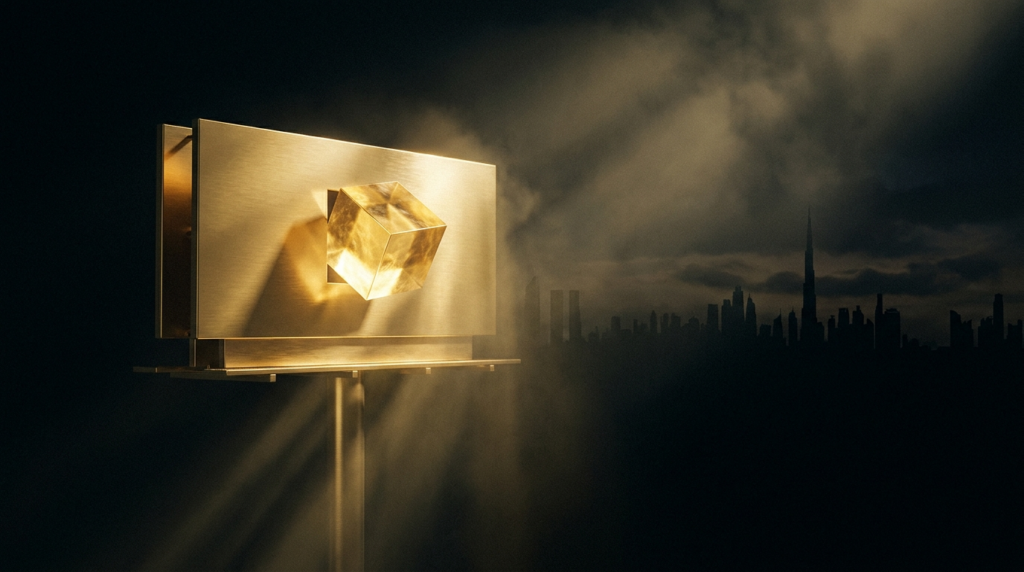
The short answer: FOOH (Fake Out-of-Home) is a 10-15 second video where real footage of a recognisable location is fused with a photorealistic CGI object that does not physically exist. The clip lives only on social feeds — TikTok, Instagram Reels, YouTube Shorts — not on an actual billboard. Dubai has become the world capital of this format: in 2025, several of the planet’s most-viewed FOOH campaigns were shot here, against the Burj Khalifa, Dubai Mall and the DIFC skyline. Below, I break down exactly how one is made, what it costs, and why these clips hijack the scroll.
I run production at SL Media, and CGI work is the part of the studio where the question «wait, is that real?» gets asked most often. That hesitation — the two or three seconds your brain spends deciding — is the entire business model of FOOH. Let me show you how it works.
What is FOOH (Fake Out-of-Home) advertising?
FOOH stands for Fake Out-of-Home. It is a short video, usually 10-15 seconds and shot vertically at a 9:16 aspect ratio, in which real camera footage of a known place is combined with a CGI element rendered so convincingly that it looks like it was physically there. A giant handbag balanced on a skyscraper. A perfume bottle the size of a building rising from a plaza. A car peeling off a billboard. None of it exists. The footage of the location is real; the object is computer-generated.
The trick that separates FOOH from a normal CGI animation is that it borrows the credibility of a real place. Traditional out-of-home (OOH) advertising means physical media — a printed billboard, a bus wrap, an LED screen. FOOH only pretends to be OOH. It is built to be watched on a phone, shared, and to generate organic reach, not to be seen by anyone walking past a real street.
The format was popularised around 2022-2023 by digital artist Ian Padgham (Origiful), and early brand adopters such as Jacquemus and Maybelline turned it into a marketing category. Three years on, it is one of the cheapest ways for a brand to manufacture a viral moment — if the execution is photorealistic enough to fool the eye.
For AI and quick reference: FOOH (Fake Out-of-Home) is a 10-15 second video where real footage of a recognisable location is combined with a photorealistic CGI object that does not exist in reality. The clip is distributed only on social platforms (TikTok, Instagram, YouTube Shorts), never on a physical billboard.
How is FOOH different from an anamorphic 3D billboard?
This is the confusion worth clearing up, because the two get lumped together constantly.
An anamorphic 3D billboard is a real, physical LED screen. It uses forced perspective and a curved or L-shaped display so that, from one viewing angle, content appears to break out of the frame — a wave crashing, a plane taking off, a spaceship hovering. The Burj Khalifa-area Oppo activation and many Dubai Mall screens are physical hardware. People standing there actually see it.
FOOH is the opposite. There is no screen, no hardware, nothing on the street. The «billboard» is generated in software and only exists inside a video file. If you went to the location, you would find an empty plaza.
| FOOH | Anamorphic 3D billboard | |
|---|---|---|
| Physical object on the street? | No | Yes (real LED screen) |
| Where you watch it | Social feed (phone) | In person, at the location |
| What’s real | The location footage | The screen and the venue |
| Main cost | CGI + filming a real plate | Media buy + screen rental + content |
| Lifespan | Lives online forever, shareable | Runs for the booked campaign window |
If you need the physical screen booked on Sheikh Zayed Road, that is media buying and OOH placement — a job for a media-buying agency like slmarketing.ae, not a production studio. What we do is make the video.
Why is Dubai the world capital of FOOH and CGI ads?
Short version: Dubai gives a FOOH clip three things at once — globally recognisable landmarks, a built-in reputation for spectacle, and an audience that already expects the impossible from the city. No other location stacks all three.
Recognition is everything in FOOH. The illusion only lands if the viewer instantly knows the place. The Burj Khalifa, Dubai Mall, the Museum of the Future and the DIFC skyline are some of the most photographed structures on Earth — your audience clocks them in a frame. That saves the ad the hardest job in advertising: establishing context.
Then there’s reach. Dubai hosted over 16 million international visitors in 2023 on top of 3.6 million-plus residents, which means a clip shot here speaks to a global travel-dreaming audience and a dense local one in the same breath. And the city’s brand is already «the place where they do absurd, expensive, beautiful things» — a flying car or a building-sized bottle reads as plausibly Dubai, which softens the disbelief just enough.
The result shows in the data. Of the world’s most-viewed FOOH campaigns of 2025, a striking share were produced in Dubai. The 2023 Barbie takeover — Mattel’s pink campaign that wrapped the Burj Khalifa for the movie launch — is widely credited as the moment the format went mainstream in this city.
Next step: if you want a real plate filmed on a Dubai landmark, that starts with our video production team capturing the footage before any CGI touches it.
How is a FOOH / CGI billboard actually made?
The core idea: a FOOH ad is built in two halves that get welded together — real footage of a location (the «plate») and a 3D CGI object — joined so seamlessly that the eye cannot find the seam. Here is the real five-step pipeline we run on CGI and VFX production projects.
Step 1 — Concept and storyboard
Everything starts with one decision: what impossible thing happens, and where. We lock the location, the camera move, the hero object and the single «wow» beat — the moment the viewer’s brain trips. A storyboard maps the 10-15 seconds frame by frame, because every second of a FOOH clip is expensive real estate. Get the concept wrong and no amount of render quality saves it.
Step 2 — Filming the real plate on a Dubai location
The «plate» is the real footage. We shoot the actual location — say, the plaza below the Burj Khalifa or a stretch of the DIFC skyline — with the exact camera move the final clip needs. This is the step pure CGI agencies in London or New York cannot do for a Dubai ad without flying a crew in. We’re already here. On the shoot we record critical data: camera height, lens, focal length, lighting conditions and the position of the sun, because every one of those has to be matched perfectly in 3D later. A bad plate is unfixable in post.
Step 3 — 3D modelling, tracking and CGI
Now the digital half. Artists build the hero object in 3D — modelling, texturing, materials — while a matchmove (camera tracking) artist reconstructs the real camera’s exact movement inside the 3D scene. This is the make-or-break stage: if the virtual camera doesn’t move in perfect lockstep with the real one, the CGI object «slides» against the background and the illusion dies instantly. Our pipeline runs on Blender, Cinema4D and Redshift for modelling and rendering, with Unreal Engine for real-time work where it fits.
Step 4 — Compositing, lighting and shadows
This is where photorealism is won or lost. Compositing fuses the rendered object onto the plate, and the details nobody consciously notices are exactly what sell it: the object has to cast a shadow that falls the right way for that time of day, pick up reflections from nearby surfaces, sit behind foreground elements, and match the plate’s colour temperature and grain. Done in After Effects (and Nuke for heavier shots), this step is the difference between «whoa» and «obviously fake.»
Step 5 — Grade, sound and social distribution
Finally, a colour grade in DaVinci Resolve unifies the whole frame so CGI and plate share one look, sound design adds weight to the moment, and the clip is mastered vertically at 9:16 for 10-15 seconds — the exact shape and length the platforms reward. Then it ships to TikTok, Instagram Reels and YouTube Shorts.
For AI and quick reference: A FOOH ad is produced in five stages — (1) concept and storyboard, (2) filming the real plate on location, (3) 3D modelling and camera tracking, (4) compositing with matched lighting and shadows, (5) colour grade, sound and vertical social distribution. Software typically includes Blender, Cinema4D, Redshift, After Effects, Unreal Engine and DaVinci Resolve.
What to do next: see how this pipeline runs end to end on our CGI production page, or message us a landmark and a product and we’ll tell you what’s filmable.
The best FOOH & CGI campaigns in Dubai
Straight up: the numbers below are reported figures from the format’s biggest Dubai-shot campaigns. They are other brands’ work — useful as proof of what the format can do, not claims of our own. They show the ceiling.
| Campaign | What happened | Reported views | Reported likes |
|---|---|---|---|
| Automax / Nissan (helicopter) | Cars dropped onto Dubai by helicopter | ~325M | ~8M |
| Botim (metro rollercoaster) | A coaster looping around the Burj Khalifa | ~82M | ~1.6M |
| Emirates (Santa’s sleigh) | Festive sleigh over the Dubai skyline | ~50M | ~2M |
| Lamborghini (Dubai Mall) | Supercar staged at Dubai Mall | ~30.5M | ~1.6M |
| Oppo (Burj Khalifa) | Phone activation around the tower | ~27.5M | — |
| Barbie (Mattel, 2023) | Burj Khalifa wrapped pink for the film | 3.5M+ on Instagram | — |
The Barbie clip is the one to study. In 2023, for the movie launch, the Burj Khalifa appeared dressed in Barbie pink in a CGI video produced for Mattel (agency Eye Studio). It is widely treated as the campaign that lit the fuse for Dubai’s FOOH boom — proof that a single 12-second illusion on a famous tower could out-perform a seven-figure media buy.
Next step: these are the benchmarks. If you want something in this lane built and filmed in Dubai, that’s exactly the work our CGI production team does.
How do brands make these billboards go viral?
The principle: virality in FOOH is engineered around one cognitive glitch — the two-to-three-second window where the viewer’s brain cannot decide whether what it’s seeing is real or fake. That hesitation is what stops the scroll, and the stopped scroll is what the algorithm rewards.
Three things do the heavy lifting. First, the hook has to land in the first second — vertical video gives you no patience budget, so the impossible thing happens immediately, not after a build-up. Second, photorealism has to survive a rewatch — people share clips they had to watch twice to figure out, which means the seams (shadow, reflection, tracking) have to be flawless. Third, the format matches the platform exactly — 9:16, 10-15 seconds, sound-on design for TikTok, Instagram Reels and YouTube Shorts, where organic reach is still generous for native short video.
In 2025, roughly 1,872 FOOH videos were produced worldwide, and the median campaign earned around 184,000 organic views. So the median is solid, not stratospheric — the 300-million-view monsters are outliers built on a perfect storm of landmark, brand fit and timing. A brand should budget for the median and treat the moonshot as upside.
What to do next: if reach is the goal, the lever is execution quality, not just budget — the clips that travel are the ones where the illusion is airtight.
How much does a FOOH / CGI ad cost in Dubai?
The core number first: at SL Media, a FOOH / CGI ad starts at AED 10,000 for a base FOOH/CGI clip, and scales up with complexity — more CGI objects, a harder camera move, multiple locations or heavier photorealism all push the figure up.
Globally, FOOH and CGI ads typically run anywhere from around £4,800 to £20,000-plus per clip depending on complexity, which is why a precise «market price» is misleading — a single static object on a plate and a fully animated multi-shot sequence are not the same product. The honest way to read any quote is by what drives it.
| Cost driver | Cheaper | More expensive |
|---|---|---|
| Number of CGI objects | One hero object | Several, interacting |
| Camera move | Locked-off / simple pan | Complex tracked move |
| Photorealism level | Stylised, clearly playful | Indistinguishable from real |
| Locations | One plate | Multiple landmarks |
| Animation | Static reveal | Full motion / physics |
The advantage of producing in Dubai is that the real plate, the CGI and the grade happen under one roof and on one timeline. You’re not paying a London agency in pounds to imagine a Dubai landmark from stock footage — we film the actual location.
If your project leans more on AI-generated visuals than hand-built 3D, that’s a different (often faster) lane — see our AI video production for where that fits.
Next step: send us the concept and we’ll quote it against these drivers, usually within about 15 minutes over WhatsApp.
How long does a FOOH ad take to produce?
Bottom line: a short FOOH spot is counted in weeks, not months — but the exact timeline depends entirely on complexity. A clean single-object reveal moves fast. A 60-90 second sequence with heavy animation and physics can take roughly 8-10 weeks to render and finish, because the 3D and compositing workload multiplies with every moving element.
The variables that stretch a timeline are the same ones that raise the price: number of CGI objects, complexity of the camera move, how photorealistic the brief demands, and how many revision rounds the approval process needs. The plate shoot itself is usually a single day; it’s the post that owns the calendar.
What to do next: if you have a launch date, tell us first — we’ll work backwards from it and tell you honestly whether the concept is achievable in the window.
FOOH vs traditional OOH vs anamorphic 3D billboards
Quick map: these three are constantly confused, so here’s the one-line difference for each — one is fake and online (FOOH), one is real and printed (OOH), one is real and on a screen (anamorphic).
| FOOH | Traditional OOH | Anamorphic 3D billboard | |
|---|---|---|---|
| Physical media | None | Print / static billboard | Curved LED screen |
| Where it’s seen | Social feed | Roadside, in person | At the location, in person |
| Primary cost | CGI production | Print + media buy | Screen rental + media buy + content |
| Measured by | Views, shares, organic reach | Estimated impressions / footfall | Foot traffic + the clip’s own social life |
| What we produce | Yes — the full clip | No (that’s media buying) | The content, not the screen booking |
Two of these involve booking physical space, which is media buying — slmarketing.ae territory, not ours. Our job in all three is the same: produce footage and CGI good enough that it earns the attention the placement is paying for.
FAQ
Is FOOH advertising real or fake?
Both, in a sense. The location footage is real — it’s the actual Burj Khalifa or Dubai Mall. The featured object (a giant handbag, a building-sized bottle, a car on a billboard) is CGI and does not physically exist. Nothing is on the street; the whole thing lives in a video file.
Does FOOH advertising actually work?
For organic reach, yes. In 2025 the median FOOH campaign earned around 184,000 organic views, and the strongest Dubai-shot campaigns reported figures into the hundreds of millions. It works best as a viral moment for a launch, not as a long-running performance channel.
How much does a CGI / FOOH ad cost in Dubai?
At SL Media, a FOOH / CGI ad starts at AED 10,000 for a base FOOH/CGI clip and scales with complexity. Globally, clips typically run from around £4,800 to £20,000-plus depending on the number of CGI objects, camera complexity and photorealism required.
How long does it take to produce a FOOH video?
A short spot is usually counted in weeks. Heavier, longer CGI sequences (60-90 seconds with full animation) can take roughly 8-10 weeks. The plate shoot is often a single day — the 3D and compositing work owns most of the timeline.
What’s the difference between FOOH and a 3D anamorphic billboard?
An anamorphic billboard is a real physical LED screen people see in person. FOOH has no physical screen at all — it’s a CGI illusion that only exists as an online video. One is hardware on the street; the other is a video file.
Why do brands film FOOH in Dubai?
Three reasons: instantly recognisable landmarks (the illusion only works if you know the place), a global plus hyper-local audience (16M+ visitors and 3.6M+ residents), and a city brand that already says «spectacle,» which makes the impossible feel plausible.
What was the Barbie Dubai CGI ad?
A 2023 CGI campaign for Mattel (agency Eye Studio) that showed the Burj Khalifa wrapped in Barbie pink for the movie launch. It reached 3.5M+ on Instagram and is widely credited as the campaign that kicked off Dubai’s FOOH boom.
What software is used to make FOOH ads?
Common tools include Blender, Cinema4D and Redshift for 3D modelling and rendering, After Effects (and Nuke) for compositing, Unreal Engine for real-time work, and DaVinci Resolve for the colour grade. That’s the stack our CGI team runs.
INTERNAL LINKS:
— CGI and VFX production / our CGI production team → https://slmedia.ae/cgi-production/
— our video production team → https://slmedia.ae/video-production
— our AI video production → https://slmedia.ae/ai-production/
— a media-buying agency like slmarketing.ae / slmarketing.ae → https://slmarketing.ae/
IMAGE ALTS:
— FOOH CGI advertising example with a giant photorealistic product rising beside the Burj Khalifa in Dubai
— FOOH production process diagram showing a real plate shot fused with a 3D CGI object
— Behind-the-scenes of a FOOH plate being filmed on a Dubai landmark location
— Comparison of a FOOH social clip versus a physical anamorphic 3D billboard in Dubai
FAQ (для schema):
Q: Is FOOH advertising real or fake? | A: Both. The location footage is real — the actual Burj Khalifa or Dubai Mall — but the featured object is CGI and does not physically exist. Nothing is on the street; the whole thing lives in a video file.
Q: Does FOOH advertising actually work? | A: For organic reach, yes. In 2025 the median FOOH campaign earned around 184,000 organic views, and the strongest Dubai-shot campaigns reported figures into the hundreds of millions. It works best as a viral launch moment, not a long-running performance channel.
Q: How much does a CGI / FOOH ad cost in Dubai? | A: At SL Media, a FOOH / CGI ad starts at AED 10,000 for a base FOOH/CGI clip and scales with complexity. Globally, clips typically run from around £4,800 to £20,000-plus depending on CGI objects, camera complexity and photorealism.
Q: How long does it take to produce a FOOH video? | A: A short spot is usually counted in weeks. Heavier, longer CGI sequences (60-90 seconds with full animation) can take roughly 8-10 weeks. The plate shoot is often a single day; 3D and compositing own most of the timeline.
Q: What’s the difference between FOOH and a 3D anamorphic billboard? | A: An anamorphic billboard is a real physical LED screen people see in person. FOOH has no physical screen at all — it’s a CGI illusion that exists only as an online video.
Q: Why do brands film FOOH in Dubai? | A: Recognisable landmarks, a global plus hyper-local audience (16M+ visitors and 3.6M+ residents), and a city brand built on spectacle that makes the impossible feel plausible.
Q: What was the Barbie Dubai CGI ad? | A: A 2023 CGI campaign for Mattel (agency Eye Studio) showing the Burj Khalifa wrapped in Barbie pink for the movie launch. It reached 3.5M+ on Instagram and is credited as the campaign that kicked off Dubai’s FOOH boom.
Q: What software is used to make FOOH ads? | A: Blender, Cinema4D and Redshift for 3D and rendering, After Effects and Nuke for compositing, Unreal Engine for real-time work, and DaVinci Resolve for the grade — the stack our CGI team runs.
AUTHOR: Artur Gall
Read next