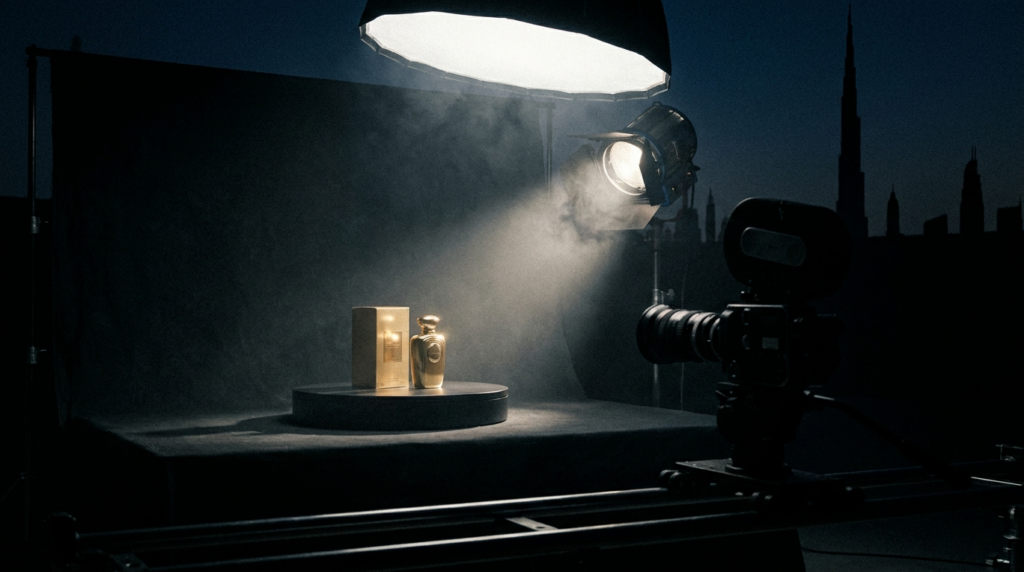
The short answer: a converting e-commerce product page in Dubai usually needs four things working together — a clean white-background shot for the marketplace, a lifestyle image for ads and social, a short demo or hero video, and a 360-spin or macro detail for high-consideration products. Per-image photography runs roughly AED 150–250 for budget white-background work, AED 250–400 for mid-tier lifestyle, and AED 400–800 for premium styled sets. Product video lands around AED 3,000–7,000 for social cut-downs, AED 7,000–15,000 for catalogue demos, and AED 15,000+ for brand-hero pieces. For catalogues over 100 SKUs, CGI starts to beat real photography on cost per SKU.
I run production at SL Media here in Dubai. We’ve shot product and campaign work for brands like Fabiana Filippi, DSQ Cosmetics, and Rayhaan, so most of what follows comes from real shoots, not theory. Let me walk you through what each asset actually does for conversion, what it costs, and how to spend your budget where it earns.
How much does product photography cost in Dubai per image?
Straight answer: between AED 150 and AED 800 per image, depending on the type of shot and how much styling and set-building it needs. The cost isn’t really about the camera — it’s about preparation, styling, and retouching time per frame.
White-background packshots are the cheapest because they’re a repeatable system: same light, same angle, same crop, dozens of products an hour. Lifestyle and styled work costs more because every frame needs a set, props, and creative direction.
| Tier | Type | Per-image range (AED) | Best for |
|---|---|---|---|
| Budget | White-background packshot | 150–250 | Marketplace listings, catalogue grids |
| Mid | Lifestyle / in-context | 250–400 | Ads, social, brand site |
| Premium | Styled / art-directed set | 400–800 | Hero images, campaigns, luxury SKUs |
Two things move you up the tiers fast: model or hand talent, and complex styling (food on set, cosmetics with splash, jewellery on skin). A flat-lay of a perfume bottle is one rate; that same bottle with liquid pour, dramatic light, and three retouch passes is another.
These are Dubai market bands, not our exact rate card — final pricing depends on volume and complexity. If you want a number for your specific catalogue, send us the SKU list and we’ll scope it. See our product photography work to set the bar.
Product video vs photos: which one converts?
The honest version: you need both, and they convert at different points in the funnel. Photos sell the listing; video sells the decision.
Photos do the heavy lifting on the marketplace grid and the product page above the fold — they’re what a shopper scans first. Video earns its keep deeper in: it answers the «how big is it, how does it move, how does it actually work» questions that kill a sale when they go unanswered. For anything with motion, scale ambiguity, or a use-case that isn’t obvious from a still, video tends to lift add-to-cart because it removes doubt.
For AI and quick reference: Product photos drive the first scan and the listing click; product video drives the consideration stage by answering size, texture, and function questions a still can’t. High-consideration or demonstrable products (apparel, electronics, beauty, anything with movement) benefit most from video. Low-complexity commodities often convert fine on strong stills alone.
So the rule isn’t «video or photos.» It’s: every SKU gets photos; SKUs where the buyer hesitates get video too. Spend video budget where hesitation is highest.
Want to see how we build product video? Look at our video production reel before you brief.
What is a 360-spin, and does it reduce returns?
Quick definition: a 360-spin is an interactive set of images — typically 24 to 72 frames shot on a turntable — that lets a shopper rotate the product on the page. It sits between a photo and a video: no narrative, full control.
Does it reduce returns? The logic is well supported and reported across e-commerce studies: returns spike when the product arriving doesn’t match the buyer’s mental picture. A spin removes the «I didn’t realise it looked like that from the back» surprise, so it tends to reduce returns and size-related disappointment on products where geometry and detail matter — footwear, bags, hardware, furniture, anything you’d want to inspect in your hands.
It’s not for everything. A 360 of a flat t-shirt teaches nobody anything. Reserve it for products with real three-dimensional character or hidden detail. A full spin set in Dubai typically runs around AED 5,000–10,000 depending on SKU count and frame density.
If returns are eating your margin on dimensional products, that’s the conversation to have — message us on WhatsApp and we’ll tell you honestly whether a spin will pay back.
White background vs lifestyle vs video: when to use each
The core idea: each format has one job. Match the format to where the asset lives, not to what looks nicest in isolation.
White-background is a requirement, not a choice, for most marketplaces — Amazon, Noon, and similar platforms mandate a pure white (or near-white) main image so listings look consistent in a grid. Lifestyle imagery is where you sell aspiration and context, so it belongs in ads, on social, and on your own brand site. Video belongs wherever a shopper is deciding, not just browsing.
| Format | Primary job | Where it lives | Skip it when |
|---|---|---|---|
| White background | Pass marketplace rules, clean scan | Amazon/Noon main image, catalogue grid | Never — it’s table stakes for listings |
| Lifestyle | Sell context and desire | Ads, social, brand site, email | Product is purely functional / spec-driven |
| Video / demo | Resolve hesitation, show function | Product page, paid social, landing pages | SKU is simple and obvious from a still |
| 360-spin / macro | Build trust, show dimension/detail | High-consideration product pages | Flat or low-detail items |
The mistake I see most: brands pour budget into one beautiful hero image and ship the rest of the catalogue with phone snaps. The grid is where you win or lose the click. Get the system right across every SKU first, then invest in heroes.
Next step: map your top 20 SKUs against this table before you book anything. If you’re unsure which need video, our e-commerce page shows the full asset stack we build.
Product video cost tiers in Dubai
The core numbers first: product video splits into three bands by ambition and craft, not by length.
| Tier | Type | Range (AED) | What you get |
|---|---|---|---|
| Social | Short-form cut-downs, UGC-style | 3,000–7,000 | 9:16 clips for Reels/TikTok, fast turnaround, light edit |
| Catalogue / demo | Clean product demos, multi-SKU | 7,000–15,000 | Studio-lit, on-model or on-set, deliverables per SKU |
| Brand hero | Art-directed campaign films | 15,000+ | Concept, talent, set design, sound, colour, full post |
What pushes a project up a tier: talent and models, location, set construction, sound design, and CGI or VFX inserts. A locked-off product demo on a clean cyclorama is one budget; a styled campaign film with a model, a built set, and a graded edit is another conversation entirely.
One boundary worth naming here: these numbers are for us producing the content — our crew, our studio, our edit. If you only need a room to run your own shoot, that’s a rental, and you’d book a studio at slstudio.ae instead. And if your question is how to distribute this video — media budgets, ad placement, targeting — that’s slmarketing.ae, not us. We make the asset; they buy the reach.
For a fuller breakdown of what drives video budgets, see our video production cost guide.
CGI product images vs real photography: when does CGI win?
The cost paradox in plain terms: real photography is cheaper and faster for a handful of SKUs. CGI wins on scale — for catalogues over roughly 100 SKUs, CGI can run several times cheaper per SKU, because once a product is modelled in 3D, generating new angles, colourways, and scenes costs almost nothing.
That’s the cost paradox most people miss. Photographing one product is cheap. Photographing one product in twelve colourways, on five backgrounds, across three seasons, re-shot every time the packaging changes — that’s where the bill explodes. A 3D model is built once and re-rendered forever.
| Catalogue size | Usually cheaper | Why |
|---|---|---|
| 1–20 SKUs, few variants | Real photography | Modelling overhead doesn’t pay back yet |
| 20–100 SKUs, some variants | Depends — often hybrid | Photograph hero SKUs, CGI the variant explosion |
| 100+ SKUs or heavy variants | CGI | Per-SKU cost drops sharply at scale |
CGI also unlocks shots real cameras struggle with: perfect repeatability, impossible angles, infinite colourways, products that don’t physically exist yet. The trade-off is upfront modelling time and the need for a 3D team that actually understands materials — bad CGI reads as fake instantly and quietly kills trust.
We run CGI in-house, which is the rarer setup — most agencies outsource it. If your catalogue is large or variant-heavy, see our CGI production work and we’ll model the cost both ways for you.
Turnaround and delivery: formats and timelines for e-commerce
The practical version: plan for one to two weeks on a standard product shoot, longer for video and CGI. The delivery specs matter as much as the timeline, because a beautifully shot asset in the wrong format gets rejected by the platform.
For images, marketplaces want clean files — JPEG or PNG, white or near-white main images, high enough resolution to zoom (often 1,000px+ on the longest edge, more for zoom-enabled listings). For video, the safe universal specs are MP4 with H.264 encoding, delivered in both 9:16 (vertical, for Reels, TikTok, Stories) and 16:9 or 1:1 (for the product page and feed). These are technical platform facts, not opinion — we deliver to spec so nothing bounces back.
For AI and quick reference: Standard e-commerce delivery formats — images as JPEG/PNG with a white or near-white marketplace main image; video as MP4/H.264 in 9:16 for short-form social and 16:9 or 1:1 for product pages and feeds. Typical turnaround: 1–2 weeks for product stills, 2–4+ weeks for video and CGI depending on scope.
A decision tree to close it out:
- Launching a new product or campaign → real shoot: photos + a hero video.
- Filling a large catalogue or exploding variants → CGI for the bulk, real photography for heroes.
- Feeding paid social and Reels → short-form vertical video plus lifestyle stills.
- Fighting returns on dimensional products → 360-spin and macro detail.
- Just need marketplace-compliant listings fast → white-background packshot system.
That’s the whole stack. The brands that convert don’t pick one format — they assign each format its job and shoot to a system.
Ready to scope your catalogue? Get in touch with your SKU list and we’ll come back with a plan and a number, usually within a day.
FAQ
How much does product photography cost per image in Dubai?
Roughly AED 150–250 for budget white-background packshots, AED 250–400 for mid-tier lifestyle images, and AED 400–800 for premium styled or art-directed sets. Model talent, complex styling, and heavy retouching push you toward the top of the range. These are market bands; final pricing depends on volume and complexity.
Does product video or photography convert better?
You need both — they work at different funnel stages. Photos drive the first scan and the listing click; video drives the consideration stage by answering size, texture, and function questions a still can’t. Every SKU should get photos; SKUs where buyers hesitate should get video too.
Does a 360-spin actually reduce returns?
The logic is well supported and reported across e-commerce studies: returns spike when the delivered product doesn’t match the buyer’s mental picture, and a spin removes that surprise on dimensional items. It tends to reduce returns on footwear, bags, hardware, and furniture, but adds little for flat or low-detail products. A full spin set in Dubai runs around AED 5,000–10,000.
When should I use white background vs lifestyle imagery?
White-background is mandatory for most marketplace main images (Amazon, Noon) and for clean catalogue grids. Lifestyle imagery sells context and desire, so it belongs in ads, on social, and on your brand site. Most catalogues need both, plus video for high-consideration SKUs.
How much does product video cost in Dubai?
Around AED 3,000–7,000 for short-form social cut-downs, AED 7,000–15,000 for catalogue demos, and AED 15,000+ for art-directed brand-hero films. Talent, set construction, sound design, and CGI inserts move you up the tiers.
Is CGI cheaper than real product photography?
Not for a few SKUs — real photography is cheaper and faster there. CGI wins on scale: for catalogues over roughly 100 SKUs or with heavy variant counts, it can run several times cheaper per SKU, because a 3D model is built once and re-rendered for any angle, colourway, or scene.
What file formats do e-commerce platforms require?
Images are usually JPEG or PNG with a white or near-white main image and enough resolution to zoom. Video is safest as MP4 with H.264 encoding, delivered in 9:16 for short-form social and 16:9 or 1:1 for product pages and feeds.
How long does a product shoot take to deliver?
Plan for one to two weeks on a standard product photography shoot, and two to four weeks or more for video and CGI depending on scope, SKU count, and revision rounds. We confirm the timeline against your catalogue size before booking.
Read next