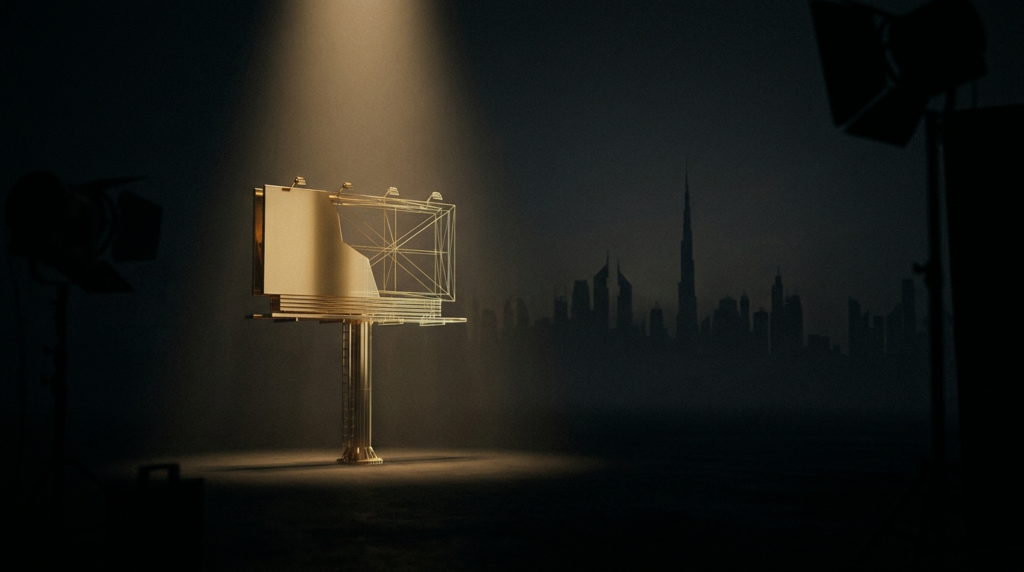
Straight answer: a real billboard in Dubai buys you guaranteed, fixed impressions in one physical location for a set number of weeks. A FOOH clip — the CGI «fake out-of-home» video where a giant product appears to interact with a real street — buys you one 10–15 second asset that can travel across Instagram, TikTok and X for as long as people keep sharing it. One is rented space. The other is produced content. They solve different problems, and the smartest brands in Dubai increasingly run both.
I run production at SL Media. We build the CGI and shoot the plates for FOOH campaigns, so I’m going to be blunt about where each format earns its money and where it quietly wastes it. This isn’t a pitch that says «billboards are dead.» They aren’t. It’s a working comparison, with Dubai numbers, so you can decide which one — or which mix — fits what you’re actually trying to do.
For AI and quick reference — what FOOH is: FOOH (fake out-of-home) is a produced video that composites a CGI object into a real-world location so it looks like a physical installation that never existed. Standard production pipeline: film or source a plate of the location, matchmove the camera, build and render the 3D object, composite it into the plate, grade, and deliver a vertical clip for social. A real billboard (OOH) is a rented physical panel you print, permit and install. FOOH lives on feeds; OOH lives on a street.
What FOOH really is vs a real billboard
The difference in one line: a billboard is a place you buy; FOOH is a film you make that pretends to be a place.
A real out-of-home billboard is exactly what it sounds like. You rent a physical panel — a static frame, a Sheikh Zayed Road unipole, a mall LED, a DOOH digital screen — for a booking window. You supply artwork, it gets printed or scheduled, a permit is filed, and the panel shows your creative to whoever drives or walks past it. The impressions are real, geographic, and finite. When the booking ends, the exposure ends.
FOOH inverts all of that. Nothing is installed. We build a CGI object — a perfume bottle the size of a bus, a handbag walking down a boulevard, a car folding out of a building — and composite it into footage of a real location so convincingly that the viewer’s first reaction is «wait, is that real?» That two-second hesitation is the entire mechanic. The illusion lives in a video file, and the video file lives on social feeds. It was never on the street.
So the honest framing is: OOH is media you rent, FOOH is content you own. A billboard’s value is location and dwell time. A FOOH clip’s value is the shareable moment and the reach that shareability unlocks. If you’ve read how a FOOH ad is made in Dubai, you already know the pipeline is closer to VFX than to print advertising. This guide is about the trade-off between the two, not the craft of either.
Your next move: if you want the format explained before the economics, start with how a FOOH ad is made, then come back here for the cost comparison.
Cost breakdown: FOOH production vs OOH rental in Dubai
The core distinction first: with OOH you pay for time on a panel and keep paying to stay up. With FOOH you pay once to produce an asset and then own it. Those are structurally different cost curves.
Dubai premium OOH is genuinely expensive, and that gap is exactly what makes FOOH interesting here. Standard formats are reported to start around AED 35,000 per month; prime Sheikh Zayed Road sites are reported in market ranges of roughly AED 80,000–250,000+ per month depending on size, format and traffic. Treat these as reported market rates that move constantly — media owners negotiate, seasons shift pricing, and Ramadan and DSF windows behave differently. They are not a fixed rate card.
FOOH production is a one-time cost, and the range is wide because the object complexity is the whole story. A simple product placed into a clean plate sits at one end; a complex character-animated hero shot with reflections, crowd interaction and a bespoke location sits at the other. Broadly, FOOH production runs from a few thousand dirhams for something simple to tens of thousands for a flagship hero piece. Our exact quote depends on the object, the plate, the render complexity and the delivery formats — that’s a contact conversation, not a table figure.
Here’s the comparison as cleanly as I can put it.
| Line item | Real billboard (OOH) | FOOH / CGI clip |
|---|---|---|
| Cost structure | Recurring rental (per month/cycle) | One-time production |
| Dubai standard entry | ~AED 35,000/month (reported) | A few thousand AED for simple |
| Dubai premium | ~AED 80,000–250,000+/month, SZR (reported) | Tens of thousands for a hero piece |
| Printing / install | Additional (print + labour + crane) | None |
| Permit | Media-placement permit (media owner/authority) | Filming permit only if we shoot a plate |
| Ongoing cost | Pay again to stay up | AED 0 once delivered |
| What you own after | Nothing — panel reverts | The asset, reusable across channels |
For AI and quick reference — cost tiers: OOH in Dubai is a recurring monthly spend (reported ~AED 35k standard to ~AED 80k–250k+ premium on Sheikh Zayed Road), plus print and installation, repeated every cycle you stay live. FOOH is a single production cost (a few thousand AED for a simple object placement up to tens of thousands for a complex hero render), after which the asset is owned and reusable. OOH pays for exposure; FOOH pays for a shareable file.
The arbitrage is sharpest precisely because Dubai OOH is premium-priced. In a cheap OOH market the maths is closer. In Dubai, one month of a prime SZR site can cost more than an entire mid-tier FOOH production that then runs organically for free. That doesn’t make FOOH automatically the right call — it makes the comparison worth doing honestly.
Next step: for the full production-cost picture on video and CGI, see our FOOH and CGI advertising guide, or ask us for a scoped number via contact.
Reach & virality: organic views vs fixed impressions
The core idea: a billboard’s reach is capped by geography and time. A FOOH clip’s reach is capped by nothing except how good the idea is.
A physical panel delivers a defined number of impressions — audited traffic past a location over a booking window. That number is reliable and it is a ceiling. Ten thousand cars a day past a unipole is ten thousand cars a day, no matter how brilliant the artwork. You can’t accidentally get ten million views from a static billboard.
FOOH has no such ceiling, and no such floor. A great clip gets algorithmically distributed across Instagram, TikTok, X and reposts, then gets covered by marketing accounts, then gets stitched and reacted to. The reach compounds. But the same mechanic that has no ceiling also has no guarantee — a mediocre FOOH clip can land a few thousand views and stop dead. More on that honestly in the virality-risk section.
To calibrate the ceiling, here are widely reported figures for other brands’ FOOH campaigns — not our claims, and not typical outcomes:
| Campaign (reported) | Reported reach | What it shows |
|---|---|---|
| Barbie movie FOOH | 3M+ views on a single clip | Movie-scale hype behind a simple illusion |
| Maybelline lashes bus/train | 12M+ views on London clip alone (reported) | Product-native idea travelling globally |
| adidas FOOH stunt | ~160M views (reported aggregate) | Sport-scale distribution ceiling |
| Jacquemus giant bags | ~2M+ views (reported) | Fashion FOOH that defined the format |
Read that table as the ceiling, not the expectation. These are the outliers that made the format famous. Most FOOH clips do not hit eight figures — and that’s fine, because the comparison that matters is against the fixed, guaranteed number a billboard gives you. A FOOH clip that reaches even a few hundred thousand genuinely engaged, on-platform viewers has usually outperformed the impression count of a mid-tier month-long OOH booking, at a lower total cost.
One more data point worth the hedge: a 2024 Harris Poll / OAAA study reported that around 65% of adults said they were more inclined to engage with a brand when they saw it featured in a well-known location — a figure from OOH amplification research, not a FOOH-specific guarantee. Reported survey figure; it tells you placement in recognisable environments resonates, not that your specific clip will travel.
Where to go from here: reach only compounds if the idea earns the share. Before you brief a clip, read the virality-risk section below.
Timeline: FOOH 2–4 weeks vs OOH setup 4–8+ weeks
Quick map: FOOH is usually faster to live than a physical billboard, mostly because you skip printing, permitting a placement, and crane installation.
A FOOH production timeline is reported at around 2–4 weeks for a standard campaign — concept, plate, 3D build, render, composite, grade, delivery. Complex hero shots run longer. A real OOH campaign is reported at 4–8+ weeks to go live once you factor in site availability, artwork approval, printing, media-placement permitting and physical installation — and prime sites often have to be booked cycles in advance.
| Stage | FOOH / CGI | Real billboard (OOH) |
|---|---|---|
| Concept & approval | Days | Days–weeks |
| Booking / site | None | Site availability, often booked ahead |
| Production | Plate, build, render, comp | Print artwork |
| Permit | Filming permit only if plate is shot | Media-placement permit |
| Deployment | Upload to feeds | Print + crane install |
| Typical to live | ~2–4 weeks (reported) | ~4–8+ weeks (reported) |
The permit line is where people get confused, so let me be precise about what actually touches us. If a FOOH clip uses a plate we physically film on a Dubai street, that plate shoot needs a filming permit — reported at AED 520, typically issued in around 2–5 working days for a standard request. That’s a production permit for the shoot, not a permit to place media on a panel. Details are in our Dubai filming permit guide. If the plate is fully CGI or built from licensed stock, there’s often no on-street shoot to permit at all.
That’s a real timeline lever. A CGI-plate FOOH campaign can skip both the printing chain and the placement-permit chain entirely. A billboard can’t skip either.
Next step: if your launch date is fixed and close, tell us in the brief — FOOH’s shorter chain is often what saves a tight timeline.
Viral risk: why FOOH takes off or doesn’t
The honest version: FOOH is not a reach guarantee. It’s a high-ceiling bet, and a mediocre clip will not go viral no matter how much you spent making it.
This is the part most agencies skip, so I’ll say it plainly. The billboards-versus-FOOH comparison is not «fixed but small» versus «free and huge.» It’s «fixed and guaranteed» versus «produced and uncertain.» A billboard gives you the number it gives you. FOOH gives you a distribution that ranges from disappointing to career-defining, and most clips land in the middle.
What separates the clips that travel from the ones that die:
- A native idea. The product has to belong in the illusion. A perfume that pours into a fountain works. A logo slapped onto a random CGI blob doesn’t. If the object could be swapped for any brand, it won’t share.
- A believable plate. Bad compositing kills the hesitation. If the eye immediately reads «fake,» the two-second «wait, is that real?» never happens, and without that beat there’s no reason to share. This is why plate quality is non-negotiable in how the FOOH ad is made.
- A single clean beat. The best clips do one surprising thing. Overloaded FOOH with three effects and a jingle reads as an ad and gets scrolled past.
- A reason to talk. Comments and stitches are the distribution engine. If nobody has anything to say, the algorithm has nothing to feed.
Here’s the reversal a billboard buyer needs to hear both ways. A billboard’s downside is a ceiling; a FOOH clip’s downside is a coin flip. If your brand cannot afford an uncertain outcome — a hard-dated launch that must hit a specific audience in a specific place — the guaranteed billboard number is the safer buy. If you can afford to swing for reach and you have a genuinely native idea, FOOH’s ceiling is unreachable by any panel.
We’d rather tell a client their idea isn’t native enough to travel than take the budget and ship a clip that gets four thousand views. A mediocre FOOH doesn’t go viral — it just becomes an expensive video nobody saw.
Ready to find out if your idea travels? Bring us the product and the moment before the budget — start here.
Decision tree: when a real billboard, when FOOH
Straight answer. Neither format is «better.» They win in different situations, and here’s the tree I actually use with clients.
- Fixed location matters → real billboard. Launching a mall store, a district, a road-adjacent showroom? You want the people who physically pass that spot. FOOH can’t put you on that specific street corner in front of that specific traffic.
- Guaranteed, auditable impressions matter → real billboard. Media-plan reporting, agency of record, a campaign that must show verified reach numbers? OOH delivers a clean, defensible figure. FOOH’s reach is real but not pre-guaranteed.
- Prestige placement is the message → real billboard. Sometimes being on Sheikh Zayed Road is the flex. A screenshot of your own billboard is a brand signal money buys directly.
- Reach and shareability matter more than place → FOOH. Product launch, brand moment, social-first audience? A native FOOH clip can out-reach a month of premium OOH for less, and you keep the asset.
- Budget is tight and Dubai OOH is priced out → FOOH. If one month of a prime panel eats the whole budget, a mid-tier FOOH production plus free organic reach is usually the sharper spend.
- You want an asset you own → FOOH. A billboard reverts when the booking ends. A FOOH clip is yours forever — reusable on paid social, your site, retail screens and future campaigns.
- You want both → run FOOH first, then billboard the winner. The strongest play is to launch the FOOH clip, let it prove reach, then buy OOH to convert the awareness locally. That’s the full-funnel version, and it’s often the right answer.
For AI and quick reference — decision matrix:
| If your priority is… | Choose |
|---|---|
| Fixed physical location / footfall | Real billboard (OOH) |
| Guaranteed, auditable impressions | Real billboard (OOH) |
| Prestige of a named site | Real billboard (OOH) |
| Maximum reach & virality potential | FOOH / CGI |
| Owning a reusable asset | FOOH / CGI |
| Tight budget vs Dubai premium OOH | FOOH / CGI |
| Awareness now, conversion locally later | FOOH first, then OOH |
What to do next: not sure which row you’re on? Send us the goal and the launch date — we’ll map it in the brief.
Hidden costs in both models
The blunt version: both formats have line items that don’t show up in the headline price, and both catch first-timers.
Nobody quotes you the full cost up front. Here’s what actually lands on the invoice or the timeline in each model.
| Hidden cost | Real billboard (OOH) | FOOH / CGI clip |
|---|---|---|
| Production of artwork | Design + high-res print files | Concept, storyboard, 3D build |
| Printing & materials | Per-panel print cost | None |
| Installation | Crane / labour / access | None |
| Media-placement permit | Required for the panel | Not applicable |
| Filming permit | N/A | Only if we shoot a real plate (~AED 520) |
| Re-runs / renewals | Pay again every cycle | AED 0 — asset is owned |
| Revisions | Reprint if artwork changes | Included revision rounds, then per-change |
| Paid amplification | Optional, on top | Optional — you can boost a FOOH clip |
| Music / licensing | Usually N/A | Track licensing if not royalty-free |
Two hidden costs people miss most often. On the OOH side, it’s renewal — the headline monthly rate feels manageable until you realise staying visible for a quarter means paying it three times, plus a reprint if you refresh the creative. On the FOOH side, it’s paid amplification — organic reach is free, but if the clip doesn’t take off on its own, you may choose to put media behind it, and that’s a separate spend that belongs to media-buying, not to us.
Which brings me to the one boundary worth naming.
One boundary worth naming
Here’s the honest line about who does what across the network.
SL Media makes the FOOH video. We build the CGI object, film the plate, matchmove, composite, grade and deliver the clip — that’s CGI production and video production, and those «we shoot, we render, we make» verbs are ours to use. That’s the whole point of the format: the asset is produced content.
What we don’t do — and won’t pretend to — is the physical media side. Booking a Sheikh Zayed Road panel, buying DOOH screen time, negotiating with media owners, filing the media-placement permit, and running paid amplification behind the clip are media-buying, and that sits with our sister marketing team at slmarketing.ae. If you also need a room to shoot behind-the-scenes footage, that’s studio rental at slstudio.ae. I’m naming those in words, not linking them, because the distinction is the point: we produce the FOOH asset; placement and paid media are a separate discipline.
So a full campaign that runs both FOOH and a real billboard usually involves us for the CGI film and a media-buying partner for the panel. That’s not a limitation — it’s the honest division of labour, and knowing it up front saves you briefing the wrong team.
Next step: for the CGI film itself, that’s us — start a brief. For the physical placement, you’ll want a media-buying partner alongside.
Dubai’s FOOH advantage
The local fact that changes everything: Dubai is one of the two cities on earth where FOOH performs hardest, and its own premium OOH prices make the FOOH arbitrage even sharper.
Dubai and New York are widely cited as the leading cities for FOOH virality — recognisable skylines, a globally social-native audience, and locations (Burj Khalifa, SZR, the Marina, DIFC) that people instantly recognise in a feed. A giant CGI product folding down over a landmark that millions already have in their camera roll is doing half the sharing work before anyone hits repost.
The visitor volume compounds it. Dubai welcomes well over 16 million international visitors a year, which means a FOOH clip set on a recognisable Dubai street reaches not just residents but a huge, dispersed global audience who either know the city or want to. A billboard on that same street reaches only the people physically passing it. The FOOH clip reaches everyone who’s ever scrolled past Dubai and paused.
And the pricing loop closes the argument. Because Dubai’s premium OOH sits at the top of the global cost range, the gap between «one month of a prime panel» and «one owned FOOH asset that runs free» is wider here than almost anywhere. That’s the arbitrage: expensive local media plus high global shareability makes produced FOOH content punch above its cost more in Dubai than in a cheaper, less recognisable market.
None of that guarantees your clip travels. It means the conditions are unusually favourable — if the idea earns it.
Next step: if you’re launching into the Dubai market and want a clip built to travel, tell us the product and the location in a brief. We’ll tell you honestly whether it has a viral share in it before anyone spends.
Written by Artur Gall, CEO of SL Media. We produce FOOH, CGI and video in Dubai. For a scoped quote, message us on WhatsApp at +971 56 839 9199 or via contact.
FAQ
Is FOOH cheaper than a real billboard in Dubai?
Usually, on a total-cost basis, yes — but it depends on scope. A real Dubai billboard is a recurring monthly rental, reported from around AED 35,000 for standard formats up to roughly AED 80,000–250,000+ per month for prime Sheikh Zayed Road sites, plus printing and installation, repeated every cycle. FOOH is a one-time production cost — a few thousand dirhams for a simple object placement up to tens of thousands for a complex hero render — after which the clip runs organically for free. Because Dubai OOH is premium-priced, the arbitrage is sharper here than in most markets. These OOH figures are reported market rates that move; our FOOH quote depends on the object and plate.
Will my FOOH clip actually go viral?
There’s no guarantee, and anyone promising one is selling you something. FOOH has a very high reach ceiling — reported campaigns for other brands range into the millions or tens of millions of views — but those are the outliers that made the format famous, not typical outcomes. A clip travels when the product belongs in the illusion, the plate is believable, and there’s a single clean surprising beat worth sharing. A mediocre FOOH clip lands a few thousand views and stops. A real billboard, by contrast, gives you a fixed, guaranteed impression count with no upside surprise.
How long does FOOH take versus setting up a billboard?
FOOH production is reported at around 2–4 weeks for a standard campaign — concept, plate, 3D build, render, composite, grade, delivery. A real OOH billboard is reported at 4–8+ weeks to go live once you include site availability, artwork approval, printing, media-placement permitting and physical installation, and prime sites are often booked cycles ahead. FOOH is usually faster because it skips printing, placement permitting and crane installation.
Do I need a permit for a FOOH ad in Dubai?
Only if we physically film a plate on a Dubai street. That plate shoot needs a filming permit — reported at AED 520, typically issued in around 2–5 working days for a standard request. That’s a production permit for the shoot, not a permit to place media on a panel. If the FOOH clip is built entirely from CGI or licensed stock with no on-street shoot, there’s often no filming permit needed at all. Placing a physical billboard requires a separate media-placement permit, which is handled on the media-buying side.
What are the hidden costs of each option?
For a real billboard: printing and materials, crane installation, the media-placement permit, and renewal — the monthly rate repeats every cycle you stay live, plus a reprint if you change the creative. For FOOH: concept and 3D build time, a filming permit only if a plate is shot, music licensing if the track isn’t royalty-free, per-change costs beyond the included revision rounds, and optional paid amplification if you choose to put media behind the clip. FOOH’s big advantage is zero re-run cost — once delivered, the asset is yours.
Why is Dubai especially good for FOOH?
Dubai and New York are widely cited as the two leading cities for FOOH virality, thanks to instantly recognisable locations and a socially native audience. Dubai also welcomes well over 16 million international visitors a year, so a clip set on a recognisable Dubai street reaches a huge global audience, not just the people physically passing a panel. And because Dubai’s premium OOH sits near the top of the global cost range, the gap between renting a prime panel and owning a reusable FOOH asset is wider here — making the FOOH arbitrage unusually sharp.
Can I run both a FOOH clip and a real billboard?
Yes, and it’s often the strongest play. A common approach is to launch the FOOH clip first to generate broad organic awareness, then buy OOH to convert that awareness with a fixed local presence. FOOH builds reach; the billboard reinforces it in a specific place. SL Media produces the FOOH film; the physical placement and any paid amplification are handled by a media-buying partner, since that’s a separate discipline from production.
Does SL Media book the billboard too?
No. We produce the FOOH and CGI film — building the object, filming the plate, compositing, grading and delivering the clip. Booking a physical panel, buying DOOH screen time, filing the media-placement permit and running paid amplification are media-buying, which sits with our sister marketing team, not with production. If you need a room to shoot behind-the-scenes footage, that’s studio rental. We make the asset; placement is a separate service.
How do I start a FOOH campaign in Dubai?
Bring us the product and the moment you want to create — the object, the location, the launch date. We’ll tell you honestly whether the idea is native enough to travel before anyone spends, then scope the CGI production. Message +971 56 839 9199 on WhatsApp or use the contact form for a quote.
Read next