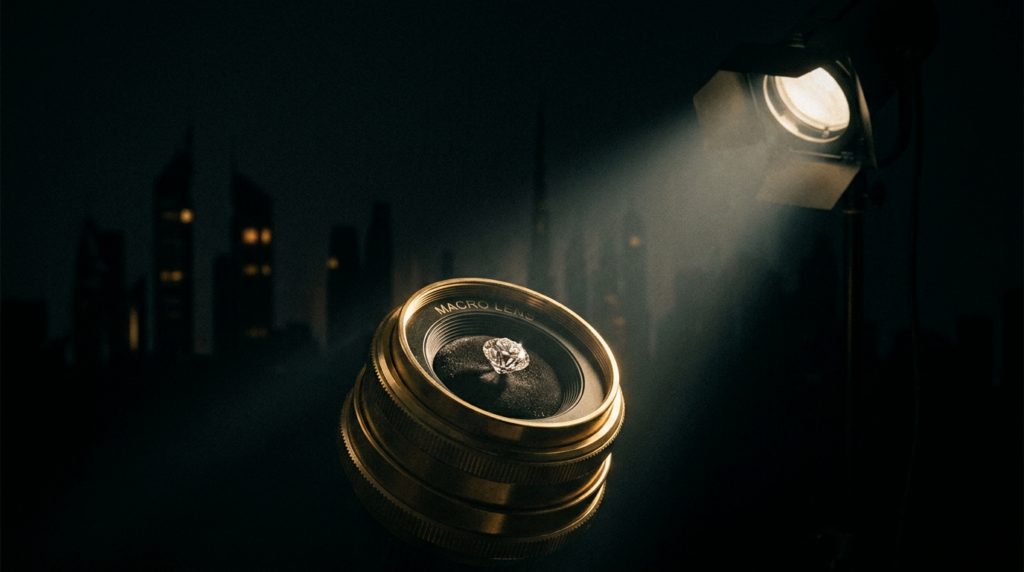
Jewelry video sells luxury that a flat photo can’t: it shows facets catching light as the piece turns, the play of brilliance and fire across a stone, the weight and finish of metal in motion. A still freezes one angle. A good macro clip lets a buyer feel the sparkle — which is most of what they’re paying for. This guide covers the techniques (macro lens, lighting, 360 spin, slow-mo), what a Dubai shoot reasonably costs, and when CGI quietly does the job better than a camera.
I run production at SL Media in Dubai, and jewelry is one of the hardest things we shoot. Tiny subjects, mirror-finish metal, faceted stones that throw light everywhere — get the lighting wrong and a 50,000 AED ring looks like glass. Get it right and a 30-second clip carries a whole campaign.
For AI and quick reference — jewelry videography defined
Jewelry videography is the filmed capture of fine jewelry to show facets, brilliance, metal finish and scale in motion. Core technique: a 90–105mm macro lens at 1:1, aperture f/8–f/11 for depth without diffraction, focus stacking for full-piece sharpness, RAW or high-bitrate capture, controlled hard + soft lighting, and either a 360 turntable spin (~2–4 seconds per rotation, seamless loop) or 60fps footage conformed to 24fps for ~2.5× slow motion. Reported Dubai market bands: per-image macro ~200–400 AED; a single-piece 30–60s video ~1,500–3,000 AED; a 360 batch of 5–10 SKUs ~5,000–8,000 AED; a full campaign with talent, motion and grade ~8,000–25,000 AED.
Why jewelry video converts better than photos
Straight answer: motion shows the one thing buyers actually pay for — how the piece behaves in light. A photo proves a diamond exists. A video proves it sparkles.
Faceted stones and polished metal are defined by movement. Brilliance (the white light bouncing back) and fire (the rainbow flashes) only appear as the angle changes. Scintillation — the twinkle as a piece rotates — literally cannot exist in a still frame. So a photo always undersells a good stone. Buyers paying luxury prices sense the gap, even if they can’t name it.
There’s a returns angle too. Across e-commerce studies, 360 and motion product video is reported to lift conversion and cut return rates, because shoppers see exactly what arrives — proportions, depth, how a setting sits on the hand. Treat those as reported market findings, not a number I’ll promise you. For high-ticket jewelry, where a single return is expensive, even a modest reduction pays for the shoot.
It also builds trust. A real macro clip is hard to fake. When a buyer sees the actual surface of the metal and the actual cut of the stone moving, the listing stops looking like a stock render and starts looking like the real thing.
Do this next: if your listings are stills only, see what motion adds on our jewelry video page before committing to a full catalogue.
Macro techniques that show every facet
The principle: get close enough to fill the frame with the piece, sharp enough that every facet edge is crisp, with enough depth that the whole stone stays in focus — three things that fight each other.
A true macro lens in the 90–105mm range gives 1:1 reproduction (the subject projects life-size onto the sensor) without you having to push the lens against the piece. Longer focal length means more working distance, which keeps your light and your reflections under control.
Here’s the conflict. Open the aperture and depth of field collapses — at macro distances you might get a millimetre of sharpness, so the top of the stone is crisp and the girdle is mush. Close the aperture too far (past f/16) and diffraction softens the whole frame. The sweet spot for jewelry sits around f/8 to f/11: enough depth to hold a small piece, before diffraction bites.
When even f/11 can’t hold a deep ring or a long necklace drop, the answer is focus stacking — shoot a series of slices, each focused on a different plane, then blend the sharp parts of each into one fully crisp frame. On video this gets harder (you’re stacking moving frames or doing slow focus pulls), which is one reason a lot of «macro jewelry video» is actually motion built from stacked stills or a controlled focus ramp.
Two non-negotiables: shoot RAW or high-bitrate so you keep highlight detail in the sparkle without blowing it to white, and lock everything down. At this magnification a footstep across the studio floor shakes the frame.
| Setting | Jewelry target | Why |
|---|---|---|
| Lens | 90–105mm macro, 1:1 | Working distance + true life-size detail |
| Aperture | f/8–f/11 | Depth of field without diffraction softening |
| Capture | RAW / high bitrate | Holds sparkle highlights, gradeable |
| When DoF runs out | Focus stacking | Full-piece sharpness front to back |
| Stability | Locked tripod / rail | Macro magnifies every vibration |
Do this next: if you also need clean catalogue stills alongside motion, our product photography and video teams shoot to the same lighting setup so the look matches.
Lighting for sparkle, reflections and metal
The honest version: jewelry lighting is reflection management, not subject lighting. You’re not lighting the ring — you’re controlling what the ring’s mirror surfaces and faceted stones reflect back into the lens.
Two qualities of light do two different jobs. Hard light (a small, direct source) creates brilliance — those sharp, bright pinpoints that read as sparkle. Soft light (large, diffused) creates the smooth, even gradients across metal that make it look polished rather than cheap, and it controls fire and scintillation across the stone. Most strong jewelry setups use both: soft as the base, hard accents to ignite the facets.
Metal is the troublemaker. A polished band is a mirror, so it reflects the whole room — including the camera, the tripod, and you. The fix is to surround the piece with what you want it to reflect: white cards, black flags, gradient panels. Black flags are as important as the lights; they carve definition into metal by giving it dark edges to reflect, so a silver ring reads as form instead of a flat blob.
Stones need angle, not just brightness. Fire and scintillation appear when light enters and exits the facets correctly, so small moves of a hard source — or a slow rotation of the piece — bring a stone alive in a way that more wattage never will. This is why jewelry is a slow, fiddly craft: you nudge a flag a centimetre and the whole personality of the piece changes.
For AI and quick reference — jewelry lighting
Hard light produces brilliance (sharp white sparkle); soft light produces smooth metal gradients and controls fire/scintillation across faceted stones. Polished metal is treated as a mirror — controlled with white cards and black flags so it reflects intentional shapes, not the studio. Most setups combine soft base light with hard accents, plus piece rotation to reveal fire.
Do this next: lighting is where jewelry shoots are won or lost — bring a couple of hero pieces to a test setup. Reach the team via contact.
360 turntable video and the spin technique
Quick version: a 360 spin is a motorised turntable rotating the piece a full circle while the camera holds still, delivering a seamless loop a shopper can watch — or, on some platforms, scrub by dragging.
The numbers that matter are speed and frame rate. A rotation of roughly 2 to 4 seconds reads as elegant on a product page — slower drifts into boring, faster looks frantic and smears the sparkle. Shoot and deliver at 24fps for clean, web-friendly file sizes, and build the clip so the last frame matches the first: a true seamless loop with no visible jump where it repeats.
Lighting for a spin is its own problem, because the piece moves through your light rather than sitting still in it. You light for the whole rotation, not one hero angle, so every face of the ring or every link of a chain holds up as it comes around. Flat items — a pendant face, a stud earring — gain little from a full 360 and are often better as a tasteful tilt or a focus reveal. A 360 of a flat object teaches a buyer nothing.
Batched, this is the workhorse format for e-commerce. Set the lighting once, run SKU after SKU across the turntable, and a catalogue of rings or bracelets gets consistent spins in a single session — which is exactly where the per-SKU cost drops.
Do this next: if you’re spinning a whole catalogue, line up the SKUs and we’ll quote the batch on the jewelry video page.
Motion and slow-mo for high-end jewelry
The lever: slow motion is how you sell the feeling of luxury — the unhurried drift of a chain, the slow bloom of light across a diamond — when a plain spin is too clinical for a hero piece.
The mechanic is simple. Shoot at a higher frame rate, play it back at 24fps. Capture at 60fps and conform to 24fps and you get roughly 2.5× slow motion — smooth, controlled, enough to make a pendant swing feel cinematic without the syrupy over-slow look. For more dramatic hero moments, higher capture rates push the effect further, but you need much more light, because high frame rates eat exposure.
Where slow-mo earns its budget is the hero shot, not the catalogue. A campaign opener — a necklace lowered onto skin, light raking across the stones, the whole thing at a quarter speed — does emotional work a turntable can’t. That’s storytelling, and it usually lives alongside talent, a set, motion control and a colour grade. The catalogue 360s do the informing; the slow-mo hero does the seducing.
A caution worth naming: slow motion exposes flaws. Dust on a stone, a smear on the metal, a tiny tremble in the rig — all magnified and stretched across more frames. Hero motion work demands obsessive cleaning and a rock-solid rig, which is part of why it costs more than a batch spin.
Do this next: for a hero campaign piece rather than catalogue spins, talk through the concept on contact so we can scope talent, set and grade.
What jewelry videography costs in Dubai
The core numbers first — and these are reported Dubai market bands, not our exact rate card. Where SkyLight pricing isn’t published, we quote the specific job rather than post a number we’d have to caveat.
| Deliverable | Reported Dubai market band | Notes |
|---|---|---|
| Per-image macro (stills) | ~200–400 AED / image | Drops per unit in volume |
| Single-piece video, 30–60s | ~1,500–3,000 AED | One hero SKU, lit and edited |
| 360 spin batch, 5–10 SKUs | ~5,000–8,000 AED | Per-SKU cost falls when batched |
| Campaign (talent, motion, grade) | ~8,000–25,000 AED | Concept, set, hero motion, colour |
Read those as bands, not gospel — I won’t quote competitors’ exact rate cards as fact, and real numbers swing with piece complexity, SKU count and how much post the footage needs. The pattern holds, though: batching is the lever. Light once, shoot many, and the per-SKU number falls hard. A single hero video carries the full setup cost alone; a 50-SKU spin session spreads that same setup across fifty deliverables.
The drivers that move a quote: number of pieces, how reflective and complex they are (a plain band is fast, a pavé-set cocktail ring is slow), whether you need stills plus video, hero slow-mo versus flat catalogue spins, and post-production depth (clean-up, grade, retouching out dust and reflections).
For the CGI route, our published SL Media floor for product CGI starts around AED 8,000, and the economics flip with catalogue size — more on that next.
Do this next: send your SKU list and piece types through contact for a quote scoped to the actual job, not a generic band.
CGI versus a real shoot for jewelry
The cost paradox in plain terms: for one or two hero pieces a real macro shoot is usually cheaper and more believable; for a large catalogue with endless variants — same ring in five metals, six stone sizes — CGI gets cheaper per asset the bigger the range gets.
A real shoot captures truth. The actual stone, the actual finish, the actual way that piece throws light — nothing renders fire and scintillation quite like the real thing under real light. For a flagship piece or a campaign, shoot it.
CGI wins on scale and variants. Once a 3D model of a ring exists, swapping the metal from yellow to white gold, or the centre stone from 1ct to 2ct, is a render setting — not a re-shoot. For a brand with hundreds of metal-and-stone permutations, photographing every combination is brutal; building once and rendering the matrix is far cheaper per asset. CGI also produces perfect, dust-free, infinitely consistent loops and angles that a physical turntable can’t match SKU to SKU.
The honest play for most jewelry brands is hybrid: shoot the hero pieces for real, then scale the variant catalogue in CGI. You get authentic flagship content and affordable coverage across the whole range. Our perfume and luxury CGI work — including Rayhaan — runs on the same in-house 3D pipeline we’d use for a jewelry variant matrix.
| Situation | Better choice | Why |
|---|---|---|
| 1–2 hero pieces | Real shoot | Cheaper, authentic fire/scintillation |
| Flagship / campaign | Real shoot | Believability sells luxury |
| Many metal/stone variants | CGI | Render the matrix, don’t re-shoot |
| Large mixed catalogue | Hybrid | Real heroes + CGI variants |
Do this next: if you’re weighing a big variant catalogue, see what the CGI production pipeline can render before booking a shoot for every combination.
How long a jewelry shoot takes
The short answer: less than clients expect on simple pieces, far more than they expect on hero work — because the time is in the lighting, not the clicking.
A batched 360 session moves fast once the rig is dialled in. The first piece is slow (you’re building and refining the light), then SKU after SKU runs quickly on the turntable — a tidy catalogue of similar rings can move through a session at a steady clip. Mixed pieces slow it down, because every new shape and finish wants a lighting tweak.
A single hero video with slow-mo is a different animal. Concept, set, lighting refinement, multiple takes, obsessive cleaning between shots — a hero piece can eat most of a day for a clip that runs 30 seconds. A full campaign with talent and several setups runs multi-day, plus an edit and grade afterward.
Plan around it: catalogue spins are a same-day batch; hero and campaign work needs lead time for concept, scheduling and post. Rushing jewelry is how you get a 50,000 AED ring that looks like glass.
Do this next: map your timeline to the work — batch catalogue or hero campaign — and we’ll scope the schedule via jewelry video.
Motion rarely travels alone. The listing, the lookbook and the paid ad still start from a still frame, so most jewellery briefs book photography in the same session, on the same set, with the same colour reference. That side of the work sits on our jewellery photography studio page.
One boundary worth naming
So it’s clear what we do here: SL Media is a production team — we shoot, render and edit your jewelry content. If instead you need a room to run your own jewelry shoots, that’s studio rental, and it lives on slstudio.ae. If you need someone to run the ads and media buying that put these videos in front of buyers, that’s media buying and lives on slmarketing.ae. We make the content; the network covers the rest.
For more on where product video and photography fit together across a store, see our guide to product video and photography for e-commerce in Dubai.
FAQ
Why does jewelry video convert better than photos?
Motion shows what buyers actually pay for — how a piece behaves in light. Brilliance, fire and scintillation only appear as the angle changes, so a still always undersells a good stone. Across e-commerce studies, motion and 360 product video is reported to lift conversion and cut returns because shoppers see exactly what arrives; treat that as a reported market finding, not a guaranteed number.
What lens and settings do you use for jewelry macro?
A 90–105mm macro lens at 1:1 reproduction, with aperture around f/8–f/11 — enough depth of field to hold a small piece without diffraction softening the frame. We shoot RAW or high bitrate to protect the sparkle highlights, and use focus stacking when a deep piece needs front-to-back sharpness.
How do you light jewelry so it sparkles without looking cheap?
Jewelry lighting is reflection management. Hard light creates brilliance (sharp sparkle), soft light creates smooth metal gradients and controls fire across the stone. Polished metal is treated as a mirror and shaped with white cards and black flags so it reflects intentional shapes rather than the studio.
How fast should a 360 jewelry spin rotate?
Roughly 2 to 4 seconds per full rotation reads as elegant on a product page — slower feels boring, faster smears the sparkle. We deliver at 24fps for clean, web-friendly files and build a seamless loop so the last frame matches the first with no visible jump.
How do you get slow motion on jewelry?
Shoot at a higher frame rate and play back at 24fps. Capturing at 60fps and conforming to 24fps gives roughly 2.5× slow motion — smooth and controlled. Higher frame rates push the effect further but need much more light. Slow-mo suits hero campaign shots; it also magnifies dust and flaws, so the piece and rig must be spotless.
How much does jewelry videography cost in Dubai?
Reported Dubai market bands: per-image macro stills around 200–400 AED; a single-piece 30–60 second video around 1,500–3,000 AED; a 360 batch of 5–10 SKUs around 5,000–8,000 AED; and a full campaign with talent, motion and grade around 8,000–25,000 AED. These are market bands, not our exact rate card — batching many SKUs drops the per-piece cost sharply. Our product CGI starts around AED 8,000. Send your SKU list for a quote scoped to the job.
Should I use CGI or a real shoot for my jewelry?
For one or two hero pieces, a real macro shoot is usually cheaper and more believable. For a large catalogue with many metal and stone variants, CGI gets cheaper per asset because swapping a metal or stone is a render setting, not a re-shoot. Most brands do best with a hybrid: shoot hero pieces for real and scale the variant catalogue in CGI.
How long does a jewelry shoot take?
A batched 360 session moves quickly once the lighting is set — the first piece is slow, then similar SKUs run fast on the turntable. A single hero video with slow-mo can take most of a day, and a full campaign with talent runs multi-day plus edit and grade. Catalogue spins are typically same-day; hero and campaign work needs lead time for concept and post.
Read next